
Blog
How to Compare Interior Design Quotations Before You Sign

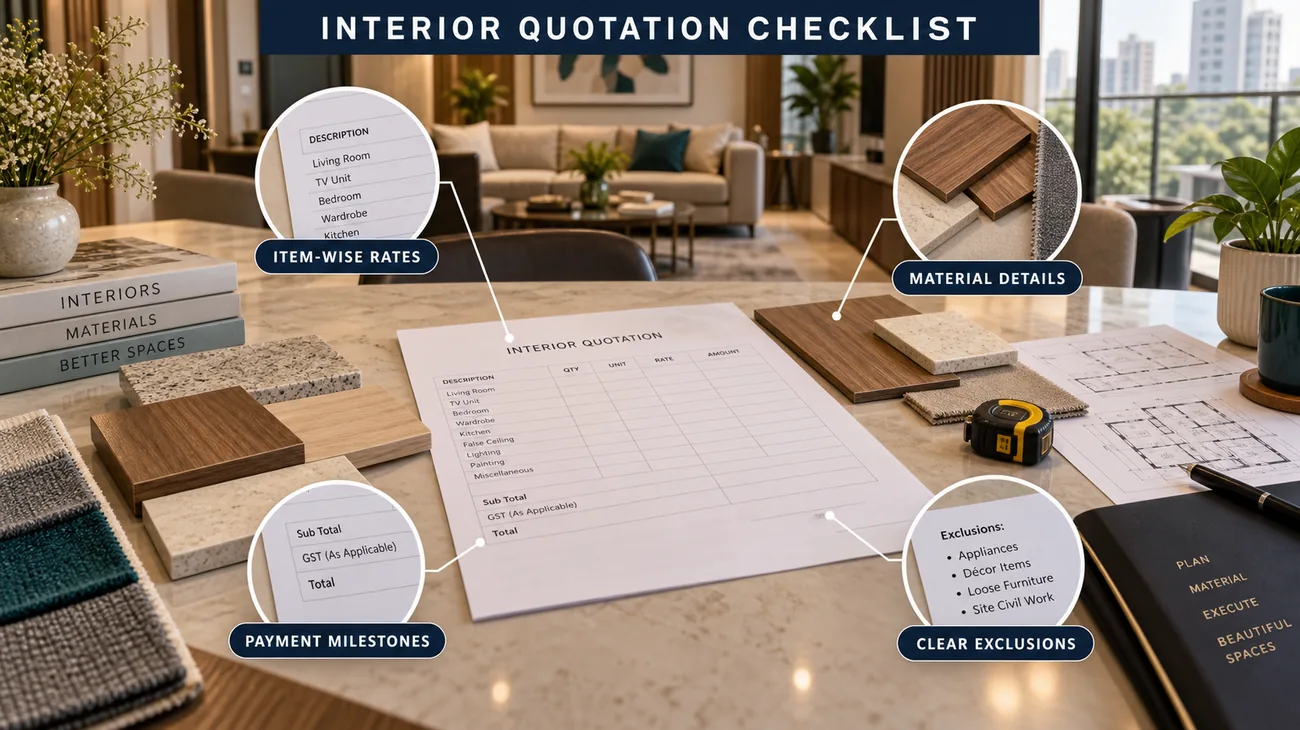
You asked three firms to quote for the same flat. One came back at a number you expected, one came back thirty per cent lower, and one came back higher than the other two put together. Nothing in any of the three documents explains why. This is the position most people in Thane are in the week before they sign, and it is a genuinely difficult one, because the quotations are not describing the same job even though the drawings look identical.
Here is the process we would use if we were the client rather than the designer.
Step one: make the scope identical before you compare anything
Most of the gap between quotations is not price. It is scope. One firm has included the false ceiling and the other has not. One has priced a full wardrobe wall in the second bedroom and the other has priced a three-door unit. One has included painting and one has left it to you.
Before comparing a single rupee, write out your own scope list — room by room, item by item — and mark each quotation against it. Anything a quotation does not mention is not included, whatever was said in the meeting. Almost every unpleasant surprise later traces back to an item that was discussed verbally and never written down.
Step two: put the numbers into the same units
Interior work is not priced in one unit, and firms do not all use the same one.
- Carpentry is quoted per running foot or per square foot of shutter area. The same wardrobe can look cheaper or dearer depending on which unit is used, so convert both to the same basis before comparing
- False ceiling is per square foot of ceiling area. Check whether the figure covers the plain ceiling only or also the cove detail and the peripheral drop
- Electrical is per point. Establish what counts as a point, because a switch, a socket and a light are sometimes counted separately and sometimes bundled
- Painting is per square foot of wall area, and the number of coats matters as much as the rate
Once everything is in the same unit, differences that looked enormous often shrink to a few per cent, and the ones that remain are usually explained by specification.
Step three: compare the specification, not the total
This is where the real money sits. Two wardrobes drawn identically can differ substantially in cost depending on three things.
The board. Commercial ply, MR ply and BWP ply are different products at different prices with different lifespans. Anything in a kitchen, a bathroom-adjacent wall or a utility area should be the moisture-resistant grade, and a quotation that does not name the grade is not letting you check.
The finish. Standard laminate, premium laminate, acrylic and veneer sit at very different price points. Ask which brand and which series.
The hardware. Hinges and drawer channels are opened several times a day for a decade. The difference between basic and good hardware is small against the total and very noticeable within a year.
If one quotation names all three and another says only “wardrobe as per drawing”, you are not looking at two prices for one job. You are looking at one price for a job that has been specified and one price for a job that has not.
Red flags worth slowing down for
- A single lump sum for the whole flat with no item-wise breakdown. It cannot be compared, and it cannot be checked as work progresses
- Payments tied to dates rather than milestones. Payment should follow completed work, not the calendar
- A large advance before any drawing is frozen or any material is ordered
- GST left unstated. A figure that is silent on tax is not a final figure
- No mention of exclusions. Appliances, loose furniture, curtains and civil work are commonly outside the price, and a quotation that does not say so is leaving you to discover it later
- A number that arrives without a site visit. Nobody can price plumbing and electrical conditions they have not seen, particularly in older Thane buildings
The questions to ask before you sign
Five questions, and the answers should be written into the document rather than given over the phone.
- What board grade and finish brand are you using, item by item?
- What is specifically excluded from this figure?
- What are the payment stages, and what work has to be complete at each one?
- Who supervises on site, how often, and who do I call when something is wrong?
- What is the warranty, what does it cover, and what voids it?
A lower quotation is not automatically a worse one
It is worth saying plainly: a lower number can be perfectly honest. A firm with its own carpentry workshop, or one that is quieter this quarter, can price lower without cutting anything. What matters is whether the specification behind the number matches the others. If it does and the price is lower, that is a genuine saving. If the specification is thinner, the saving is a deferred cost.
Frequently asked questions
How many quotations should I get?
Three is usually enough. Beyond that the comparison becomes harder to hold in your head and the process stalls. What improves the decision is not more quotations but a clearer scope list given to each firm.
Should I share one firm’s quotation with another?
Share the scope, not the price. Sharing the scope gets you comparable documents. Sharing the price mostly gets you a number shaded to sit just under it, which tells you nothing about the specification.
Is a detailed quotation a sign the firm is more expensive?
No. It is a sign the firm has actually worked out the quantities. A vague quotation is usually either padded to cover the unknowns or due for revision once the work starts.
What if the scope changes after I sign?
It sometimes does, and that is normal. What matters is that every change is priced in writing before it is executed, with its effect on the completion date stated. Changes agreed verbally on site are the most common source of billing disputes.
How long should a quotation stay valid?
Material rates move, so thirty days is a reasonable window. If a quotation carries no validity period at all, ask for one.
Next step
If you would like a quotation you can actually read line by line, send us your flat layout and a short note on what you want built. We price after a site visit, and the document you receive is broken into quantities you can check. Contact Ink Design Studio or see our completed projects.
Related reading: what drives interior design cost in Thane, full home interior design, turnkey interiors and civil work.